Key statistic
10–15 million
People displaced by the Partition of British India in 1947 (historians’ estimates).
When Independence Came with an Unthinkable Cost
August 1947 brought the end of British colonial rule and the long-awaited promise of freedom. Across the subcontinent, people celebrated independence after generations of struggle. Yet for millions of families, that same moment marked the beginning of displacement, fear and loss. Homes built over lifetimes were suddenly on the other side of a new border. Neighbours who had shared streets and markets for years faced an uncertain future. The Partition of British India was not only a political division; it was a human tragedy whose consequences extended far beyond 1947.
How British India Was Divided
As the British prepared to leave, the decision was made to partition British India into two independent dominions: India and Pakistan. The provinces of Punjab and Bengal were divided along boundaries drawn under the chairmanship of Sir Cyril Radcliffe. The boundary decisions were announced after independence, adding to confusion at a moment already marked by political tensions and communal violence. The reasons for Partition were complex, involving colonial policies, competing political demands and years of worsening mistrust. But the speed of the transfer of power left ordinary people with little time to understand what the changes would mean for their lives.
A Journey Away from Home
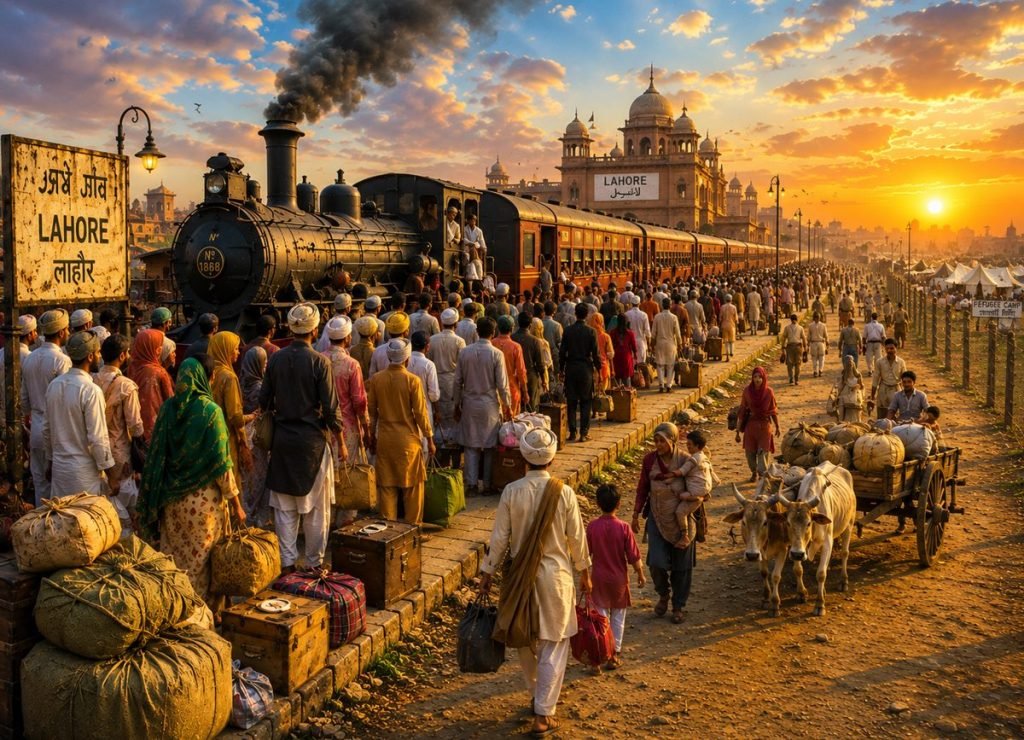
Families fled with whatever they could carry: clothes, a few utensils, documents and precious keepsakes. Trains, crowded roads and refugee columns became symbols of a migration on an extraordinary scale. Some travelled by foot or bullock cart; others boarded overcrowded trains in the hope of reaching safety. Across Punjab and Bengal, people from different religious communities were uprooted as violence, fear and uncertainty spread. Many were separated from loved ones, and some never learned what happened to those left behind. Women endured particular dangers, including abduction and sexual violence, experiences too often absent from brief accounts of Partition.
The Scale of Loss
Historians commonly estimate that roughly 10 to 15 million people were displaced, although figures vary by source and method. Estimates of deaths also differ widely, ranging from several hundred thousand to around a million or more. Behind every estimate stood individual lives and families whose worlds had been changed. Refugee camps, new neighbourhoods and government rehabilitation efforts helped many survivors rebuild, but shelter and work could not immediately replace the homes, communities and sense of belonging they had lost.
Memories That Cross Generations
The effects of Partition did not end when the borders were drawn. Families carried memories of migration into new cities and villages, often preserving stories of kindness as well as cruelty. Oral histories describe strangers sharing water, neighbours helping one another escape and people protecting those from other communities. Such accounts remind us that the period cannot be reduced to a single story of hatred. Its legacy can still be heard in family recollections, literature and the histories of India and Pakistan, as well as the wider region.
Why Remembrance Matters
Remembering Partition means honouring those who died, those who were uprooted and those who began again with almost nothing. It also calls for understanding how the ending of colonial rule, political decisions and communal conflict combined to create an immense humanitarian crisis. The proposed National Day of Commemoration for the Victims of British Colonialism offers one possible opportunity to include these lives within a broader national conversation about historical suffering. Remembrance need not assign blame to people living today. Its purpose can be to preserve testimony, recognise human dignity and help future generations appreciate the value of peace and coexistence. Freedom deserves celebration; the people who paid such a terrible price must not be forgotten.