Public Petition
Two Centuries of Loss. No Day to Remember.
A Public Petition for a National Day of Commemoration for the Victims of British Colonialism in India.
The Petition
What we are asking for
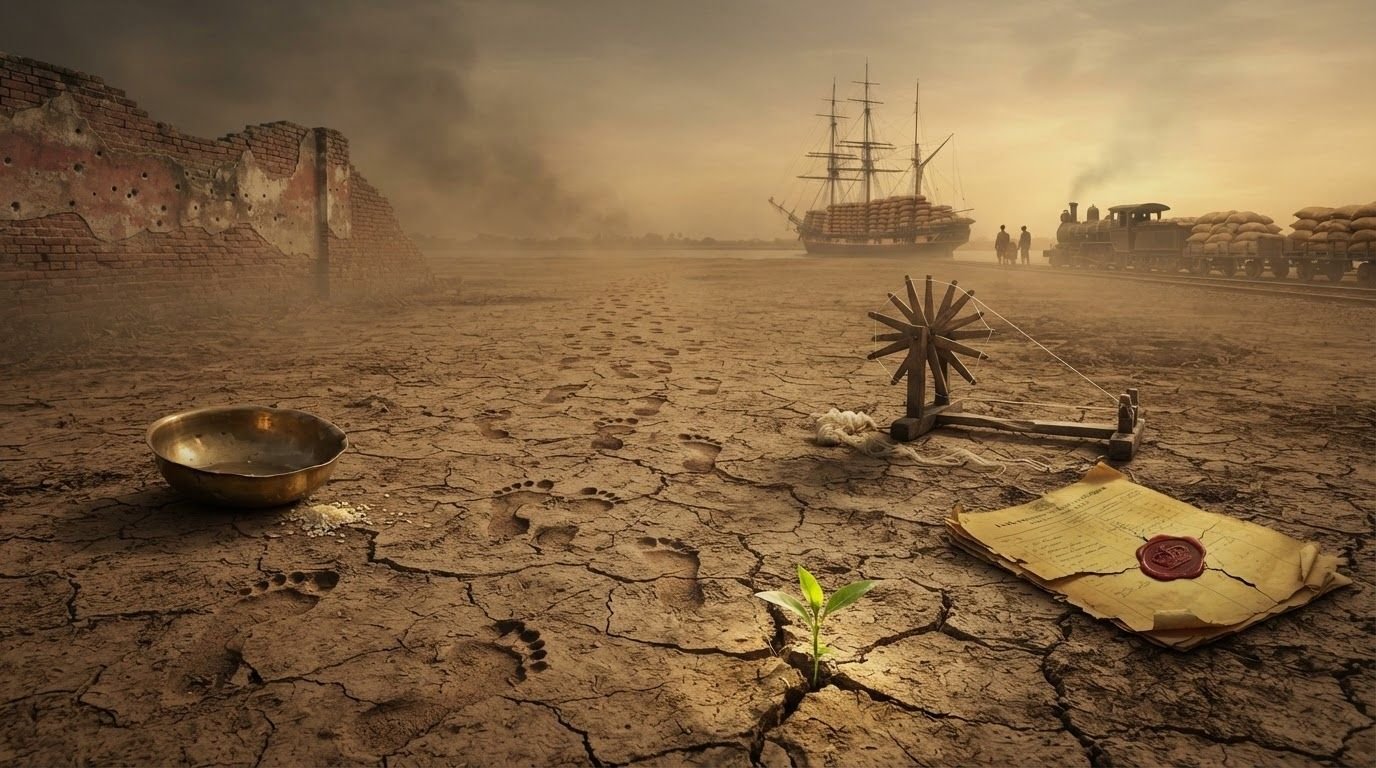
British colonial rule cost India tens of millions of lives through famine, debt, repression and division. Yet India has no day on which the nation remembers them together.
We call on the Government of India to establish a National Day of Commemoration for the Victims of British Colonialism in India — one day each year to honour everyone who suffered, resisted and died under British colonial rule, whatever their region, community or period.
From Trading Post to Empire
It began with a request to trade. In 1615, Sir Thomas Roe arrived at Emperor Jahangir’s court as the English Crown’s first official envoy, seeking privileges for the East India Company. Just 150 years later, after the battles of Plassey and Buxar, that trading company was collecting the revenues of Bengal. In 1858, the British Crown took direct control.
For nearly two centuries, British colonial rule shaped the lives of most of India’s people — and its toll is still counted in millions of lives.
The Cost
What colonial rule cost India
Economy
Debt and Landlessness
Revenue systems such as the Permanent Settlement, Ryotwari and Mahalwari demanded heavy payments even after failed harvests. Farmers borrowed from moneylenders to pay, and as interest mounted, many lost their land and became tenants or labourers. Zamindars gained vast estates, while forest laws cut tribal communities off from the land they lived on. Rural debt and unequal landholding are still felt today.
Economy & Hunger
The Drain of Wealth and Famine
Dadabhai Naoroji showed how India’s wealth was drained to Britain through salaries, pensions, remittances and administrative charges, while Indian textiles that once led world markets were undercut. At present-day value, the colonial state owes India more than US$3 trillion, a debt that has never been acknowledged, let alone repaid. With nothing left to fall back on, droughts became catastrophes. From the Bengal famine of 1770 to the Great Famine of 1876–78 in the Madras Presidency, and the Bengal famine of 1943, tens of millions died, often while revenue was still collected and grain still exported.
Partition & Riots
Repression and Division
At Jallianwala Bagh in 1919, troops fired on an unarmed crowd, killing hundreds. Policies that divided communities, from the Partition of Bengal to separate electorates, fed the communal riots that ended in the bloodshed of Partition.
Culture
Culture and Identity
As colonial rule tightened, English became the language of education, administration and advancement. Indigenous schools, languages and knowledge systems lost their patronage, countless artefacts were carried abroad, and generations were taught to see their own heritage through a colonial lens.
Why this petition matters
A nation that remembers its heroes — but not its people
There is no day for the Santhal Hul, the Revolt of 1857, the Indigo Revolt, the Champaran
Satyagraha, the Non-Cooperation Movement, the Malabar Rebellion, the Civil Disobedience Movement or the Quit India Movement. Every Indian reads about these struggles in school, yet the nation sets aside no day to honour the people who suffered and died in them.
- The Santhal Hul
- The Revolt of 1857
- The Indigo Revolt
- The Champaran Satyagraha
- The Non-Cooperation Movement
- The Malabar Rebellion
- The Civil Disobedience Movement
- The Quit India Movement
What we have instead are the birth anniversaries of individual freedom fighters, mostly marked at a regional level. The famine victim, the indebted farmer, the ruined weaver and the unnamed satyagrahi have no day of their own.
The Proposal
What a National Day would do
One day a year would honour every victim — not only the famous names. It would teach the next generation through schools and public events, encourage research and the preservation of archives and oral histories, and bring regional histories together as one national story — complementing existing observances rather than replacing them.
The date should be decided through consultation with historians, academicians and other relevant stakeholders, drawing on India’s own historical record.
Principle
Remembrance, not blame
This is a call to remember, not to blame. It assigns no guilt to anyone living today and is not directed at India’s present relations with any nation.
It is an invitation to engage with our history honestly and with dignity — so that the sacrifice and resilience of those who came before us are never forgotten.
Dig Deeper
Read the full story
Public Petition
Every supporter strengthens the case for a day of national remembrance.
Share this petition with people you think will care — colleagues, teachers, writers, friends, family. Awareness is the first step.